
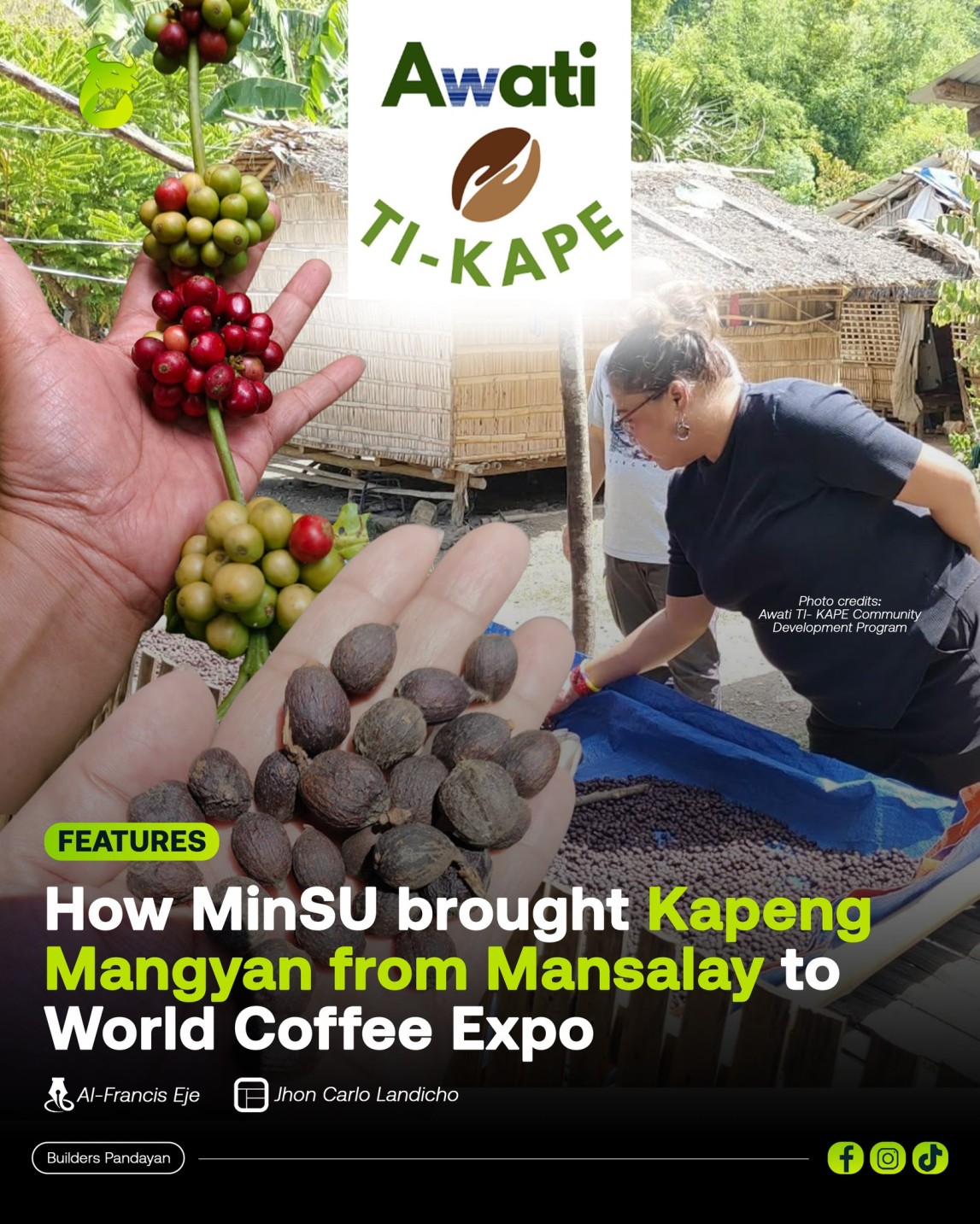
In the mountains of Panaytayan, Mansalay, Oriental Mindoro, Mangyan farmers cultivate something close to their identity and life—coffee.
Known as “Kapeng Mangyan,” this locally grown coffee is carefully harvested by the hands of the Hanunuo Mangyans and supported by the Awati Ti-Kape Community Development Program of Mindoro State University (MinSU). Today, it is brewing a legacy beyond Mindoro’s highlands.
From a small Indigenous community, its rich aroma was showcased at the World of Coffee in San Diego, California, last April 6–9, 2026. This allowed the world to experience not just how the coffee of Mindoro tastes, but also the enduring culture, labor, and perseverance of the Indigenous Mindoreños.
The Work Behind the Perfectly Brewed Legacy
Long before development programs entered the mountains of Panaytayan, the Hanunuo Mangyans were already cultivating coffee as part of their everyday lives. For more than 80 years, they have preserved their heirloom traditions and livelihood through the manual labor of planting, harvesting, and “pagbabayo” (pounding) to produce coffee for trade. Previously, they could only sell green coffee beans—raw, unroasted beans that usually fetched only ₱20 to ₱30 per kilo due to limited processing methods.
Significant changes occurred when Mindoro State University, through its Awati Ti-Kape Community Development Program and partner organizations, provided technical interventions, training, quality control, and new machinery. These resources refined and upgraded the Indigenous farmers' production process. Consequently, this led to higher profits for the Mangyan farmers, who now earn ₱80 to ₱100 per kilo of coffee beans.
Process to the Global Recognition
The Awati Ti-Kape program of MinSU also linked Kapeng Mangyan to various buyers and cooperatives, facilitated participation in expos and forums like the CALABARZON Coffee Expo, and established engagements with the Cavite State University - National Coffee Research, Development, and Extension Center (CvSU NCRDEC), further developing the skills, knowledge, and connections of the Indigenous farmers.
According to MinSU Associate Professor V and Chairperson of the Awati Ti-Kape Community Development Program, Prof. Zussette Aplaon, in an interview with DZMM Teleradyo, Kapeng Mangyan’s presence at the World of Coffee in America was made possible through a collaboration rooted in a Department of Agriculture expo. There, they met Dom’s Barako, a partner distributor who evaluated the taste and production process of Kapeng Mangyan and helped export it to the United States.
The Taste and Types
Beyond the coffee farmlands in Panaytayan, Mansalay, Kapeng Mangyan is also cultivated across Mt. Halcon and various other municipalities, including Baco and parts of southern Oriental Mindoro. Farmers plant four varieties of coffee: Robusta, Liberica, Arabica, and Excelsa.
Though the coffee varieties they plant are not native species unique to the region, the coffee they produce remains distinctively theirs because of the traditional process it undergoes. Its unique earthy, chocolaty, and winy taste offers an exhilarating finish when consumed. Every aromatic cup reflects the resilience and hard work of the Mangyan farmers.
The Value of Each Coffee Beans
Beyond its growing recognition abroad, Kapeng Mangyan has transformed the lives of many Hanunuo Mangyan families by creating additional income opportunities and increasing the value of their coffee products.
“May nakapanayam po kaming katutubo tungkol sa impact ng project. Hindi na po sila mamomroblema sa pagpapaaral sa anak. Meron na po kaming katutubo doon, nakabili na po sila ng tricycle,” Aplaon shared during her DZMM Teleradyo interview.
This simple statement reflects a major improvement in mobility and livelihood for families living in the highlands of Mindoro.
Threats to Kapeng Mangyan
Despite its growing success, Kapeng Mangyan faces several challenges. One major concern is the aging coffee trees in the mountains of Mansalay. Many existing trees have been cultivated for decades, resulting in declining productivity and lower yields over time.
To address this, MinSU has partnered with the Mansalay Local Government Unit, the Department of Labor and Employment (DOLE), the Public Employment Service Office (PESO), and cash-for-work programs. Together, they have initiated coffee tree-planting activities and sustainability programs to ensure the continuous production of Kapeng Mangyan.
A Tomorrow for Hanunuos and their Traditions
For the Hanunuo Mangyan farmers, the recognition received by Kapeng Mangyan represents more than international exposure; it symbolizes hope that their culture, labor, and identity will continue to be valued in the years to come.
As the aroma of Kapeng Mangyan continues to travel beyond the mountains of Mindoro, the community hopes that this recognition will not fade as a passing trend but will grow into a sustainable future that secures the livelihood of Mangyan farmers for generations. Through every harvested bean and every brewed cup, Kapeng Mangyan carries the powerful story of a people whose culture remains deeply rooted in the mountains they call home. (jdtdc)
via Al-Francis Eje
photo courtesy | FB/Builders Pandayan
#SDG1 #SDG2 #SDG8 #SDG10 #SDG17

302 Staff

10531 Students

9 Colleges

3 Years